
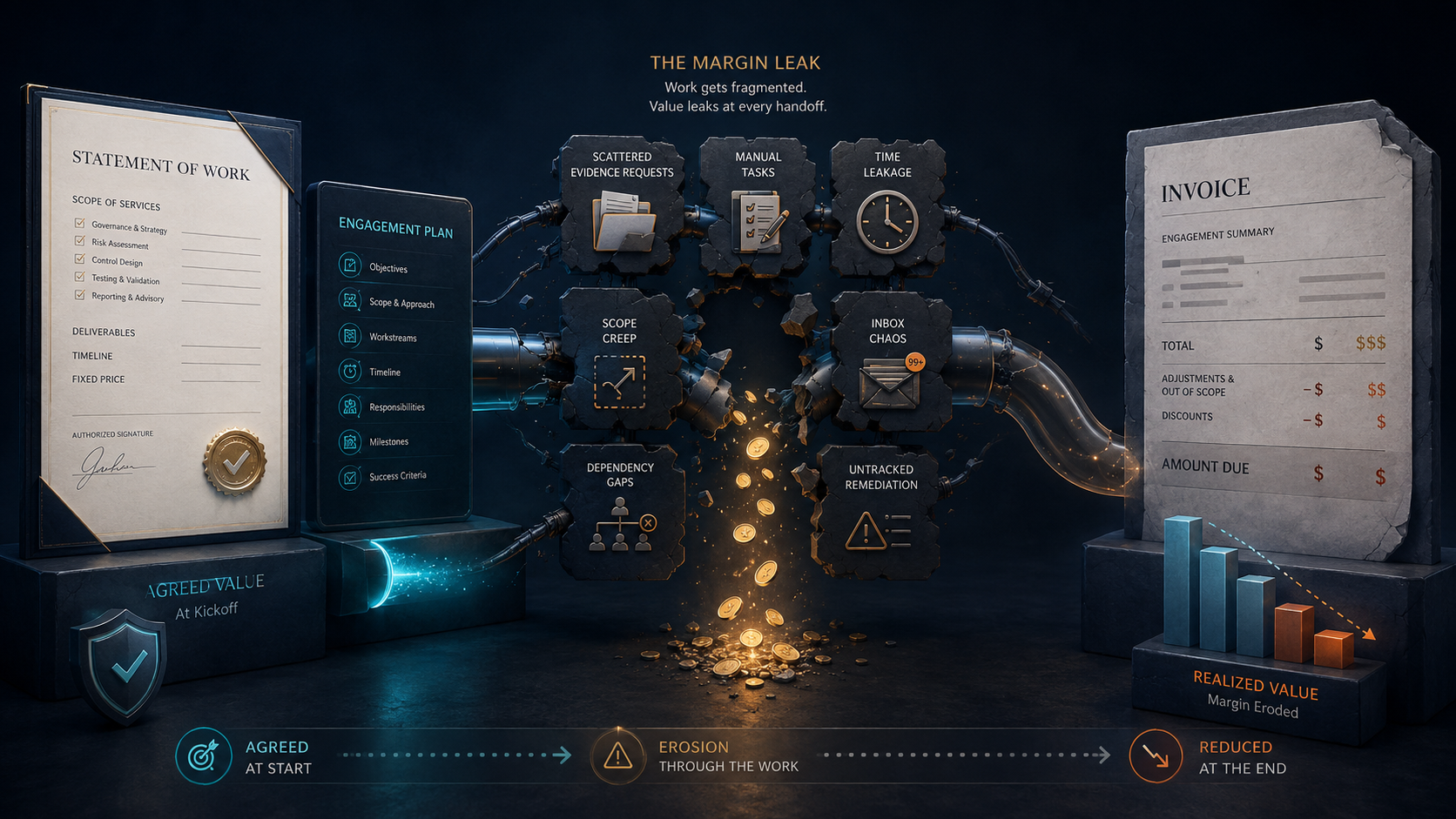
How GRC Firms Lose Margin Between the SOW and the Invoice
A GRC engagement can look perfectly healthy when it is sold. The scope seems clear, the fee makes sense, the team knows the framework, and everyone leaves kickoff believing the work is manageable and profitable.
Then the engagement starts, and small things begin to change. A client asks for an extra review. A control owner misses a deadline. Evidence comes in incomplete. A remediation item turns into three. Another meeting gets added. A consultant spends two hours chasing documentation that was supposed to be ready last week.
None of those things feels catastrophic on its own, which is exactly why they are so expensive. Margin usually does not disappear because of one dramatic mistake. It disappears through dozens of small execution decisions made between the Statement of Work and the invoice.
In most GRC firms, that work is also spread across multiple systems. The SOW may live in Word or PDF. Evidence is in email, SharePoint, or a portal. Tasks sit in a project management tool. Time is tracked somewhere else. Billing happens later. Leadership eventually sees the financial impact, but usually after the hours have already been spent.
That gap between what was sold and how the work is actually executed is where the trouble starts.
We think about that gap through what we call The Execution Chain™:
Agreement → Requirements → Deliverables → Milestones → Evidence → Remediation → Tasks → Time → Invoice → Insights
The idea is simple. Every part of the engagement should stay connected to the part before it. When that chain stays intact, you can see what was promised, what is being done, why it is being done, how much effort it is consuming, and whether the engagement still makes financial sense. When the chain breaks, people start filling in the gaps manually, and that is where margin begins to disappear.
The SOW has to be more than a sales document.
Most firms treat the SOW as a commercial document, which makes sense. It defines the work, the fee, the deliverables, and the general boundaries of the engagement. The problem is what happens after it is signed.
The delivery team starts working, but the agreement often stops functioning as an operating document. Tasks are created, evidence requests are sent, remediation work begins, and meetings get scheduled without a clear structural connection back to the original scope.
That becomes especially risky in GRC because the work often evolves as the engagement progresses. A SOW that says “SOC 2 readiness support” may sound clear enough at signing, but operationally it leaves a lot unanswered. Are policy updates included? How many review cycles are expected? Who owns evidence collection? Is remediation part of the fee? Is auditor support included? Does the engagement end at readiness, or does it continue into fieldwork?
Those are not just contract questions. They are delivery questions. If those boundaries are vague, the team ends up interpreting the agreement instead of executing it, and that is usually the first place the chain begins to break.
Requirements need to become part of the operating model.
GRC engagements are built around requirements: framework requirements, control requirements, evidence requirements, client obligations, and auditor requests. If those requirements stay buried in spreadsheets, PDFs, or somebody’s head, the delivery team starts working from assumptions.
That is how rework begins.
A requirement should be connected to the deliverable it supports and the work needed to satisfy it. Otherwise the team may be very busy without having a clear view of what the activity is actually producing. The more complex the engagement, the more expensive that ambiguity becomes.
Deliverables need a real definition of done.
Deliverables are where the commercial promise becomes concrete. In a GRC engagement, that might be a readiness assessment, gap analysis, updated policies, remediation plan, control-to-evidence matrix, auditor handoff package, or final report.
The important part is not just naming the deliverable. Both the client and the delivery team need to understand what completion actually means. If they do not, revision cycles expand, clients keep asking for more, and the team keeps polishing work without realizing the engagement has moved beyond what was originally priced.
That is how good client service quietly turns into unpaid work.
Milestones give the engagement a sequence.
One of the most common operational problems I see is a team with plenty of tasks but no clear sequence. Everything is active at once, everyone is busy, and very little is actually complete.
For a GRC engagement, a milestone structure might look like:
Scope confirmed → Assessment complete → Gaps prioritized → Remediation complete → Evidence validated → Fieldwork supported → Findings resolved → Final delivery
That sequence matters because it creates order. Evidence should not be flying around before scope is settled. Remediation should not start before gaps are prioritized. Auditor support should not arrive as a surprise at the end.
Milestones also give the team a real definition of progress. Without them, status becomes subjective. Someone says the engagement is 70% complete because a lot of work has been started, while another person looks at the same engagement and sees that almost nothing is actually finished.
Busy is not the same thing as progressing.
Evidence is work, not just documentation.
Evidence collection is one of the easiest places for a GRC engagement to lose time. Anyone who has run one knows the pattern. You request a document. The client sends the wrong version. Then they send the right file with the wrong date range. Another control owner has to approve it. Somebody reviews it and finds it does not satisfy the requirement. Then the auditor asks for something slightly different.
That process can consume a surprising amount of time.
The mistake is treating evidence as if it is just a collection of files. Evidence has owners, deadlines, dependencies, review criteria, and often multiple rounds of follow-up. It should be connected to the requirement, milestone, task, and owner it supports.
If it is not, the firm loses visibility into where the engagement is actually stuck and how much time the delay is consuming.
Remediation needs ownership.
A finding is not an outcome, and a recommendation is not remediation.
If remediation is part of the engagement, every issue needs clear ownership. Who is responsible for the fix? What needs to change? When is it due? What evidence will prove it is complete? Does it require retesting?
Without that structure, remediation becomes a growing list of things somebody needs to deal with later. That list often expands quietly while consultants keep working against the original fee.
This is one of the easiest places for an engagement to become more expensive than anyone planned.
Every task should have a reason to exist.
This is where scope gets practical.
Every task should connect back to something: a requirement, a deliverable, a milestone, or the agreement itself. If it does not, somebody should ask why it exists.
Maybe the task is necessary. Maybe it is out of scope. Maybe it is rework. Maybe it is work that should have triggered a change order.
The point is not to stop the team from helping the client. The point is to stop extra work from becoming invisible.
Scope creep becomes expensive when nobody notices it until the work is already done.
Time should tell you what is changing.
Time tracking should do more than feed payroll or invoices. It should tell you whether the engagement is behaving the way you expected.
If a milestone was supposed to take 40 hours and it has already taken 70, something changed. Maybe the estimate was wrong. Maybe the client added work. Maybe evidence collection is taking longer than expected. Maybe the team is stuck. Maybe the engagement was underpriced from the beginning.
Whatever the reason, the important thing is knowing while the engagement is still in motion.
Time without context is just a number. Time connected to tasks, milestones, deliverables, and scope becomes an operating signal.
Billing should come from execution.
Another place firms create unnecessary work is invoicing.
The engagement gets delivered, then somebody has to reconstruct what happened so the invoice can be prepared. They check time entries, reopen the SOW, scan emails, ask the delivery team what was included, and try to determine whether extra work should be billed.
That should not be necessary.
If the engagement has been structured properly, billing should be the natural result of execution. Completed milestones, approved scope changes, tracked time, and approved expenses should already be connected to the case.
You should not have to perform forensic accounting every time you invoice a client.
Insights need to arrive before the damage is done
This is the part leadership usually cares about most.
Which engagements are consuming more time than planned? Where is evidence stalled? Which milestones are slipping? Which clients are creating the most out-of-scope work? Which team members are overloaded? What work is complete but still has not been invoiced?
If the answers only show up at month-end, the information is already late.
The purpose of operational insight is not to explain what went wrong after the fact. It is to give the firm enough time to change what happens next.
The real issue is not effort.
Most GRC firms are not short on effort. Their teams are working hard.
The problem is that the work itself is often disconnected. The agreement is separate from delivery. Evidence is separate from milestones. Remediation is separate from ownership. Time is separate from scope. Billing is separate from execution. Profitability is reviewed after the fact.
That is the operating problem we built theCaseWork™ around.
theCaseWork™ connects the client agreement, delivery plan, evidence, remediation work, time, billing, and profitability in one platform. Casey, our AI assistant, can take a discovery meeting transcript and turn it into a draft SOW and structured case, then help the team manage the work, analyze what is happening, identify bottlenecks and time leakage, recommend next steps, and take action inside the engagement.
The technology matters, but the operating model comes first. If the work is broken before the first task is assigned, software alone is not going to save the engagement.
GRC firms that want to scale profitably need one connected chain from the agreement to the invoice, and they need enough visibility to see when that chain starts to break.
Think margin may be leaking inside your own delivery process?
Take the GRC Delivery Health Check to estimate how much billable capacity, revenue, and cash flow may be tied up in administrative work, revenue leakage, and delayed invoicing.