
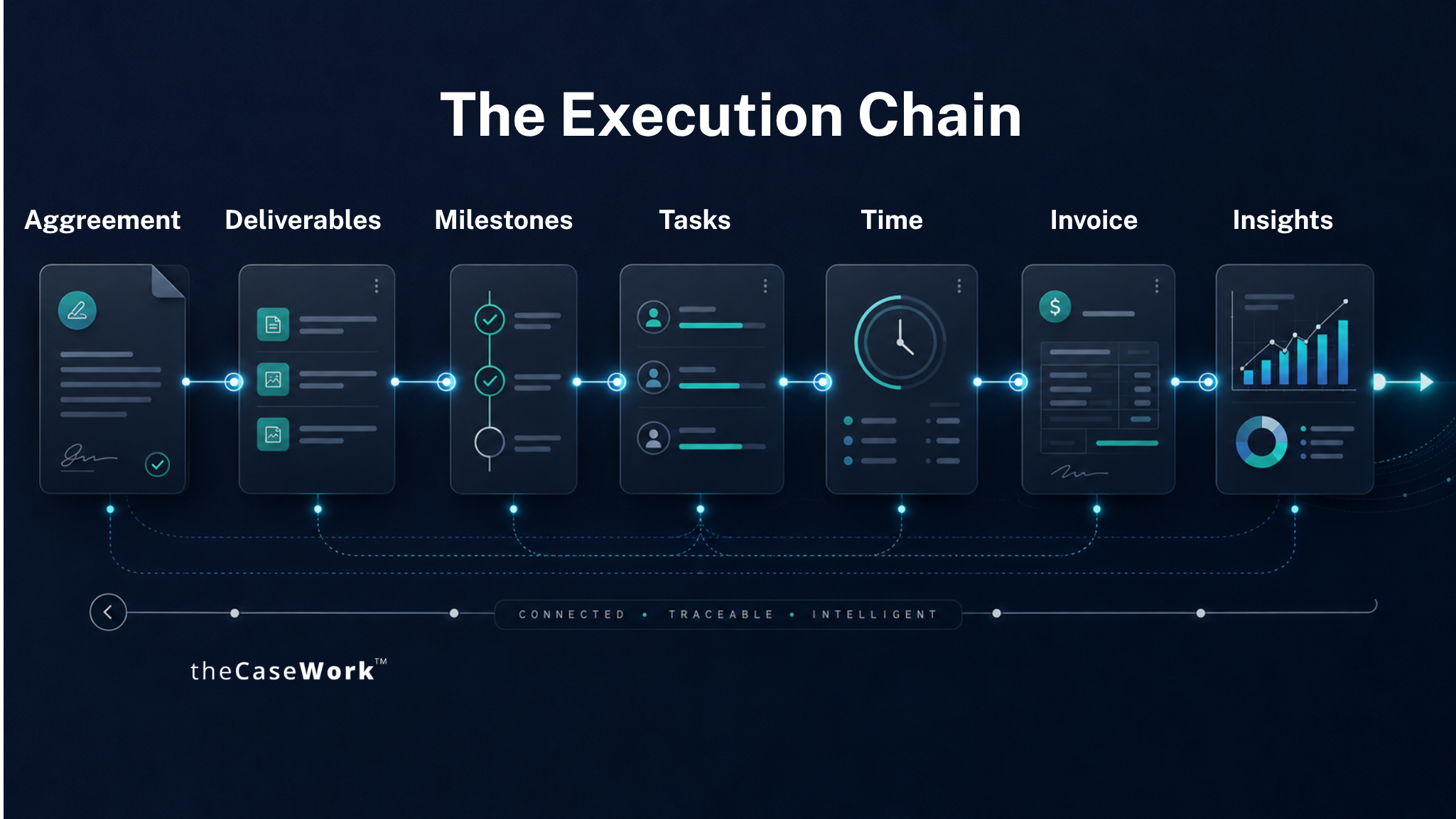
The Execution Chain™:
How Professional Services Firms Keep Work Connected From Agreement to Insight
Most professional services firms do not have an effort problem. They have a connection problem.
The agreement is signed, then the work gets recreated somewhere else. Deliverables are discussed but not always translated into a real operating plan. Tasks get added as the engagement moves along. Time is tracked in a separate system. Billing happens later. Leadership gets the financial picture after the work is already complete.
Each part may technically exist, but the pieces do not always stay connected.
That matters because margin is rarely lost in one dramatic moment. It is usually lost through small execution gaps that accumulate over time. A task gets added without anyone checking whether it was part of the original scope. A milestone slips without anyone understanding what that delay is doing to the budget. A team works extra hours because a deliverable was never clearly defined. An invoice is reduced because nobody can reconstruct how the engagement changed.
The Execution Chain™ is designed to prevent that.
The core Execution Chain™ is:
Agreement → Deliverables → Milestones → Tasks → Time → Invoice → Insights
It is not just a workflow. It is a control system. Each link gives meaning to the next one, and every unit of work should be able to trace backward to what the client agreed to buy and forward to revenue and insight.
When the chain is intact, firms can see where work is drifting before it becomes a financial problem. When it breaks, execution becomes reactive and leadership starts managing from partial information.
Agreement: Start with something the delivery team can actually use
Every engagement starts with an agreement, usually a Statement of Work. That agreement should define the scope boundaries, deliverables, pricing, and the major milestones the parties have agreed to.
The problem is that many agreements are written to close the deal, not to operate the engagement.
A SOW may be commercially acceptable while still leaving the delivery team with unanswered questions. What exactly is included? What is excluded? How many review cycles are expected? Which outcomes are the firm responsible for producing? What happens when the client asks for more?
If those questions are unclear at the agreement level, the ambiguity does not disappear once delivery starts. It spreads downstream.
That is why the agreement has to become more than a signed document. It has to become the foundation of the case.
Deliverables: Define what the client is actually paying for
Deliverables are the anchor between the commercial promise and the work that gets done.
A deliverable should be specific enough that the client and delivery team both know what will be produced and what completion looks like. If the engagement says the firm will provide an assessment, report, implementation plan, system configuration, expert opinion, or readiness package, that output needs to be clearly defined.
This is where many firms leave too much room for interpretation.
Loose deliverables create loose scope. The team keeps working because the client wants something else added, one more revision would make the work better, or a stakeholder asks for something that sounds reasonable. None of those requests may seem significant on their own, but they can quickly change the economics of the engagement.
When deliverables are clearly defined, scope changes become much easier to see. If the work does not support an agreed deliverable, someone should stop and ask why it exists.
Milestones: Translate the promise into a sequence
Deliverables tell you what must be produced. Milestones tell you how the work will move from commitment to completion.
This distinction is important because teams often have tasks without having a real sequence.
When that happens, people start wherever they can. Everything becomes urgent. Multiple workstreams begin at once. Progress becomes difficult to measure because there are no meaningful checkpoints.
A good milestone defines a phase of execution and the conditions required to move forward. It creates order, dependencies, and a shared definition of progress.
Without milestones, teams can be extremely busy while the engagement barely advances.
That is why milestone design is not administrative overhead. It is part of delivery control.
Tasks: Make every unit of work traceable
Tasks are where the engagement becomes real.
They are the day-to-day actions required to complete milestones and produce deliverables. Every task should have a clear owner, and every task should map directly to a milestone that maps to a deliverable.
If a task does not connect to the chain, that does not automatically mean it should not be done. It does mean somebody should understand why it is being added.
Maybe the work is out of scope. Maybe it is premature. Maybe it is rework. Maybe the client added a new requirement. Maybe the team discovered something the original agreement did not anticipate.
The point is to make that visible before the firm absorbs the cost.
Tasks are often where margin leakage becomes operationally invisible because small requests feel harmless. When the chain is intact, those requests have somewhere to go. They either belong to the existing engagement structure or they trigger a decision about scope.
Time: Use it for visibility, not just billing
Time tracking is often treated as a finance requirement. In reality, it is one of the strongest operating signals a services firm has.
If an engagement is fixed fee, time matters even more because the client is not automatically paying more when the team works more.
Suppose a milestone was estimated at 50 hours and the team has already logged 80. That tells you something changed. Maybe the estimate was wrong. Maybe the work expanded. Maybe the team is struggling. Maybe the client has been slow to provide inputs and the firm is absorbing the coordination cost.
Time by itself will not tell you the reason, but time connected to tasks, milestones, and deliverables gives the firm enough context to investigate.
Without that connection, firms know how many hours were worked but not what those hours are telling them.
Invoice: Billing should be the result of execution
Billing should not require someone to reconstruct the engagement from memory.
If the work was structured properly, the firm should already know what was completed, what changed, how much time was consumed, and what the client should be billed for.
That is why invoice sits inside the Execution Chain rather than outside it.
Completed work should naturally move toward billing. Approved changes should already be reflected in the engagement. Time and expenses should already be tied to the work that created them.
When billing is disconnected from execution, revenue gets delayed, work gets written off, and clients receive invoices that are harder to explain.
The more manual reconstruction required at invoice time, the more likely it is that part of the economic story has already been lost.
Insights: Turn each engagement into a learning system
The last link is where the Execution Chain becomes more than a delivery workflow.
Insights should come directly from how the engagement was executed.
Leadership should be able to see which engagements are drifting, where scope is expanding, which milestones are delayed, where margin is being lost, which clients consume the most unplanned work, and which engagement types are consistently profitable.
If that information has to be manually assembled after the fact, the firm is not really operating from insight. It is conducting an autopsy.
The point of insight is to improve the current engagement while there is still time to act and to improve the next engagement before it begins.
That is how execution becomes a compounding operating advantage instead of a collection of isolated projects.
What happens when the chain breaks?
Most firms do not lose control because they completely ignore structure. They lose control because they skip links.
The agreement goes straight to tasks. Tasks go straight to time. Time goes straight to an invoice.
Everything in the middle is assumed.
That is where interpretation enters the process, and interpretation is expensive.
If deliverables are unclear, tasks drift. If milestones are missing, progress becomes subjective. If tasks are unstructured, time loses context. If time is disconnected from the work, billing becomes harder to defend. If billing is disconnected, insight becomes unreliable.
That is why every link matters.
The GRC application of the Execution Chain
For GRC firms, the same control system applies, but the work has two additional operating layers that are too important to leave implied.
The GRC-specific Execution Chain™ is:
Agreement → Requirements → Deliverables → Milestones → Evidence → Remediation → Tasks → Time → Invoice → Insights
Requirements translate the framework, scope, and client obligations into work the engagement must satisfy. Evidence shows whether those requirements are being met. Remediation turns gaps and findings into accountable action.
Those additions do not replace the core Execution Chain. They show how the same operating model applies to the realities of GRC delivery.
The principle stays the same: every piece of the engagement should remain traceable from what was agreed to what was delivered, what it consumed, what was billed, and what the firm learned.
A better way to run client work
The Execution Chain™ is not complicated, and it does not need to be.
Its value comes from forcing a basic discipline that many firms lose as they grow: keep the work connected.
Do not let the agreement disappear once delivery starts. Do not let tasks float outside milestones. Do not track time without understanding what it supports. Do not wait until invoicing to figure out what happened. Do not wait until the engagement closes to learn whether it worked.
Every case should tell one continuous story from agreement to insight.
That is the operating structure theCaseWork™ is built to support. The platform connects the agreement, deliverables, milestones, tasks, time, billing, and insights so firms can see when execution begins to drift rather than discovering it after the margin is already gone.
Want to see where your own delivery operation may be leaking time and revenue? Take the GRC Delivery Health Check or see how theCaseWork™ keeps The Execution Chain™ connected from the first client conversation through invoice using The CASE Method™.