

The CASE Method™:
A Better Operating System for Professional Services Delivery
Professional services firms spend a lot of time improving individual parts of delivery.
They refine templates. They buy project management software. They tighten time tracking. They improve invoicing. They add dashboards.
Those things can help, but they do not solve the underlying problem if the engagement itself is not being managed as one connected system.
That is the thinking behind The CASE Method™.
The CASE Method™ is built on a simple principle: in professional services, every client engagement is a case. A case has an agreement, defined deliverables, milestones, structured work, measurable effort, revenue, and an outcome that should teach the firm something about how to operate better next time.
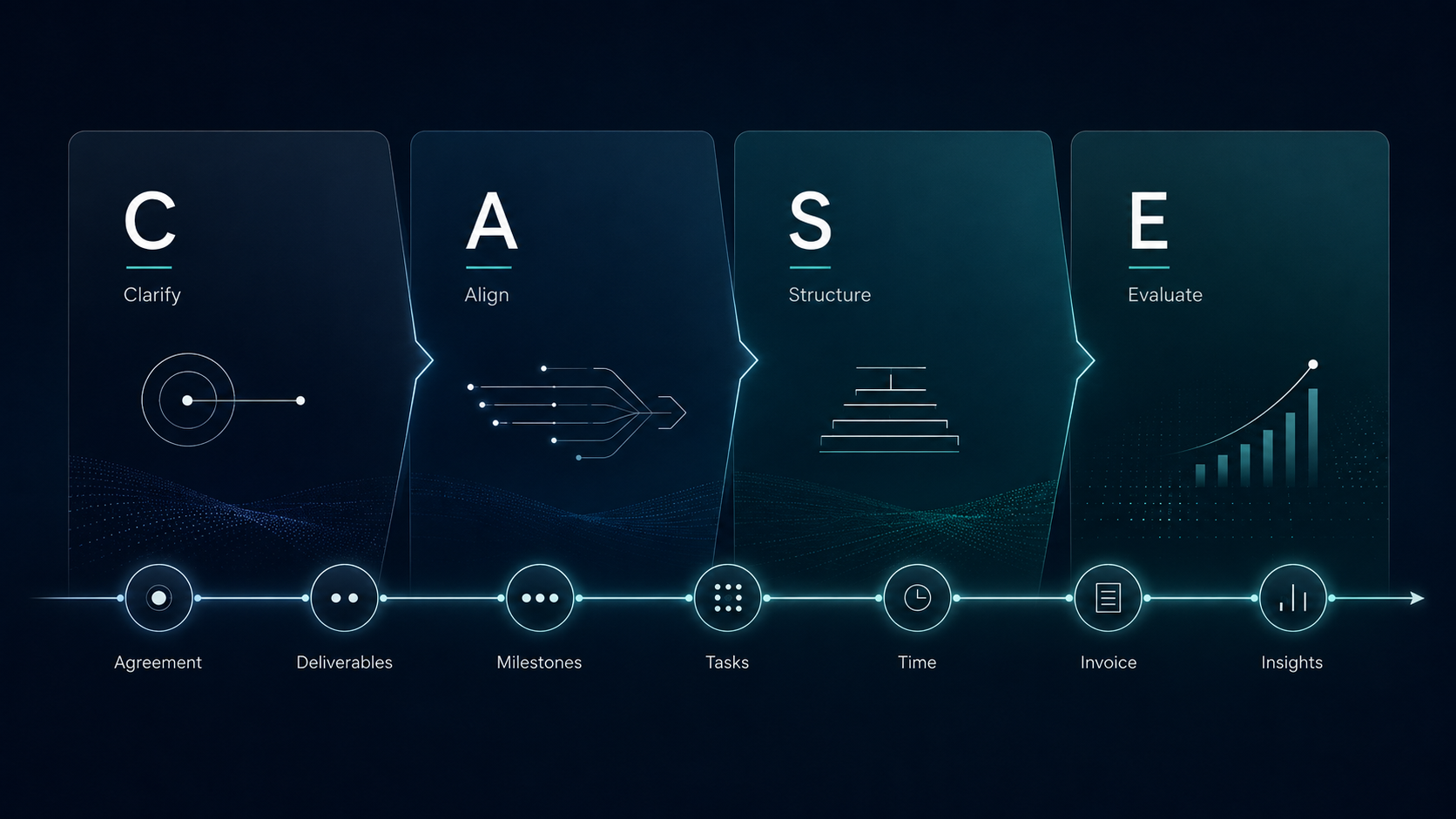
The method has four parts:
C — Clarify the Agreement
A — Align the Execution
S — Structure the Work
E — Evaluate the Outcome
Inside The CASE Method™ sits The Execution Chain™:
Agreement → Deliverables → Milestones → Tasks → Time → Invoice → Insights
The CASE Method™ defines how the engagement should be managed. The Execution Chain™ defines how the work moves through that operating model. Together, they create a structure for keeping scope, effort, revenue, and insight connected throughout the life of the engagement.
C- Clarify the Agreement
Most execution problems begin earlier than firms think.
They do not begin when the first task is late. They begin when the agreement leaves too much room for interpretation.
The agreement establishes the commercial and operational foundation of the engagement. It should define the scope, pricing, deliverables, and major expectations clearly enough that the delivery team can actually use it.
That distinction matters because a contract can be legally acceptable and still be operationally weak.
If the agreement says the firm will “support implementation,” “provide advisory services,” or “assist with readiness,” the delivery team may still have no clear answer to what is included, what is excluded, how much review is expected, or what completion means.
Once execution begins, people fill in those gaps themselves.
That is where scope starts becoming subjective.
Clarifying the agreement means taking the commercial promise and turning it into something the team can execute. Deliverables are central to that because they define what the client is actually paying for and create the boundary between included work and additional work.
If the firm cannot clearly explain the deliverables before execution starts, the engagement is not ready.
A- Align the Execution
Once the agreement and deliverables are clear, the next question is how the work should actually progress.
This is where milestones matter.
Milestones translate the agreement into operational phases. Deliverables define what must be produced. Milestones define the path the team will take to produce it.
A surprising number of engagements skip this step.
The agreement gets signed, a project plan gets created, and people start receiving tasks. There may be dozens of tasks, but no shared sequence, no meaningful checkpoints, and no clear conditions for moving from one phase to the next.
That creates a lot of activity without necessarily creating progress.
Aligning execution means giving the engagement an order that everybody can understand. What has to happen first? What does completion of this phase look like? What dependency has to be resolved before the next phase can begin? What does the client need to provide?
Milestones become the control points that answer those questions.
Without them, teams work reactively and leaders rely on status updates that may sound confident but are difficult to verify.
S- Structure the Work
This is where firms either maintain control or lose it.
Once milestones are defined, the work has to be broken into tasks with ownership, scope boundaries, and expected effort.
Every task should connect to a milestone, and every milestone should connect to a deliverable.
That sounds simple. It is also one of the easiest disciplines to lose once a client engagement gets busy.
A client asks for something small. Someone adds the task because it needs to get done. A meeting creates three follow-ups. A revision turns into another round of work. None of those additions may look significant enough to stop the engagement.
But tasks are where scope creep becomes real.
If a task does not connect to an agreed deliverable, somebody should decide whether it belongs in the engagement before the work is performed.
Structure also means knowing who owns the task. Work without ownership gets delayed. Work with multiple owners often has no real owner at all.
Then there is time.
Time should be captured against the work that created it, even in fixed-fee engagements. This is not about turning every firm into an hourly billing shop. It is about understanding what the engagement is actually consuming.
A fixed-fee engagement can appear healthy right up until the firm discovers that the team used twice the expected effort to produce the same revenue.
Time tied to structured work gives leaders an earlier warning.
Billing belongs in this stage too because the invoice should result from execution. The firm should not need to reopen the SOW and reconstruct six weeks of activity to understand what the client owes.
Expanded work should either be recognized as part of the agreed engagement or surfaced as something that requires an additional commercial decision.
E- Evaluate the Outcome
This is the step many firms neglect entirely.
The engagement ends, the invoice goes out, everybody moves to the next client, and the operating lessons disappear with the project.
That is expensive because the same mistakes repeat.
Evaluating the outcome means comparing what actually happened against the original agreement.
Did the firm stay within scope? If not, where did the scope expand? Did the engagement preserve the expected margin? Which milestones took longer than expected? Which client behaviors created unplanned work? Which delivery decisions helped? Which ones created rework?
The answers should not depend on somebody remembering what happened three months later.
They should come directly from the execution data.
That is why Insights is the final link in the Execution Chain. It turns each case into an improvement system.
Leadership should be able to see which engagements are drifting, which are most profitable, where scope is expanding, which milestones are delayed, where margin is being earned or lost, and which clients consume the most unplanned work.
When those answers come from execution rather than manually assembled reports, the firm can improve both the current engagement and the way future engagements are sold and delivered.
Why The CASE Method™matters
The CASE Method™ is not a project management methodology.
It is an operating model for professional services.
Project management usually begins after the work has already been sold. The CASE Method™ begins with the agreement because that is where the economics of the engagement begin.
It also does not stop when the tasks are complete. It continues through time, billing, and insight because delivery is not successful simply because the client received the work.
A professional services engagement also has to make economic sense for the firm.
That is the part many delivery systems leave fragmented.
The CASE Method™ in GRC
GRC is a good example of why this structure matters.
A readiness or compliance engagement may begin with a clear commercial goal, then quickly expand into requirements, evidence requests, control reviews, remediation work, auditor questions, client dependencies, and multiple rounds of follow-up.
Without a strong operating model, that work spreads across spreadsheets, portals, email, project tools, and time systems.
The core CASE Method™ still applies, but the GRC execution chain adds the layers that matter most to that work:
Agreement → Requirements → Deliverables → Milestones → Evidence → Remediation → Tasks → Time → Invoice → Insights
The method has not changed, only the operating detail has.
Clarify the agreement and requirements. Align the delivery phases. Structure evidence, remediation, tasks, ownership, time, and billing. Evaluate what happened and use those insights to improve the next engagement.
That is what running the case looks like in GRC.
The technology should support the method, not replace it.
We built theCaseWork™ around The CASE Method™ because software should reinforce a sound operating model rather than force a firm to invent one around the limitations of the tool.
theCaseWork™ keeps the agreement, delivery plan, work, time, billing, and profitability connected. Casey, our AI assistant, can help turn discovery conversations into structured engagements, analyze what is happening across the work, recommend next steps, and take action inside the system.
But the technology is not the method.
The method is what determines whether the engagement is structured correctly in the first place.
That distinction matters because automation makes good operations faster, but it also makes bad operations faster.
The goal is not to automate chaos.
The goal is to create a better way to run the case.
Want to see how The CASE Method™ applies to GRC client delivery? Explore the GRC Engagement Operating Model to see how theCaseWork™ turns the method into a connected operating system for client work.