
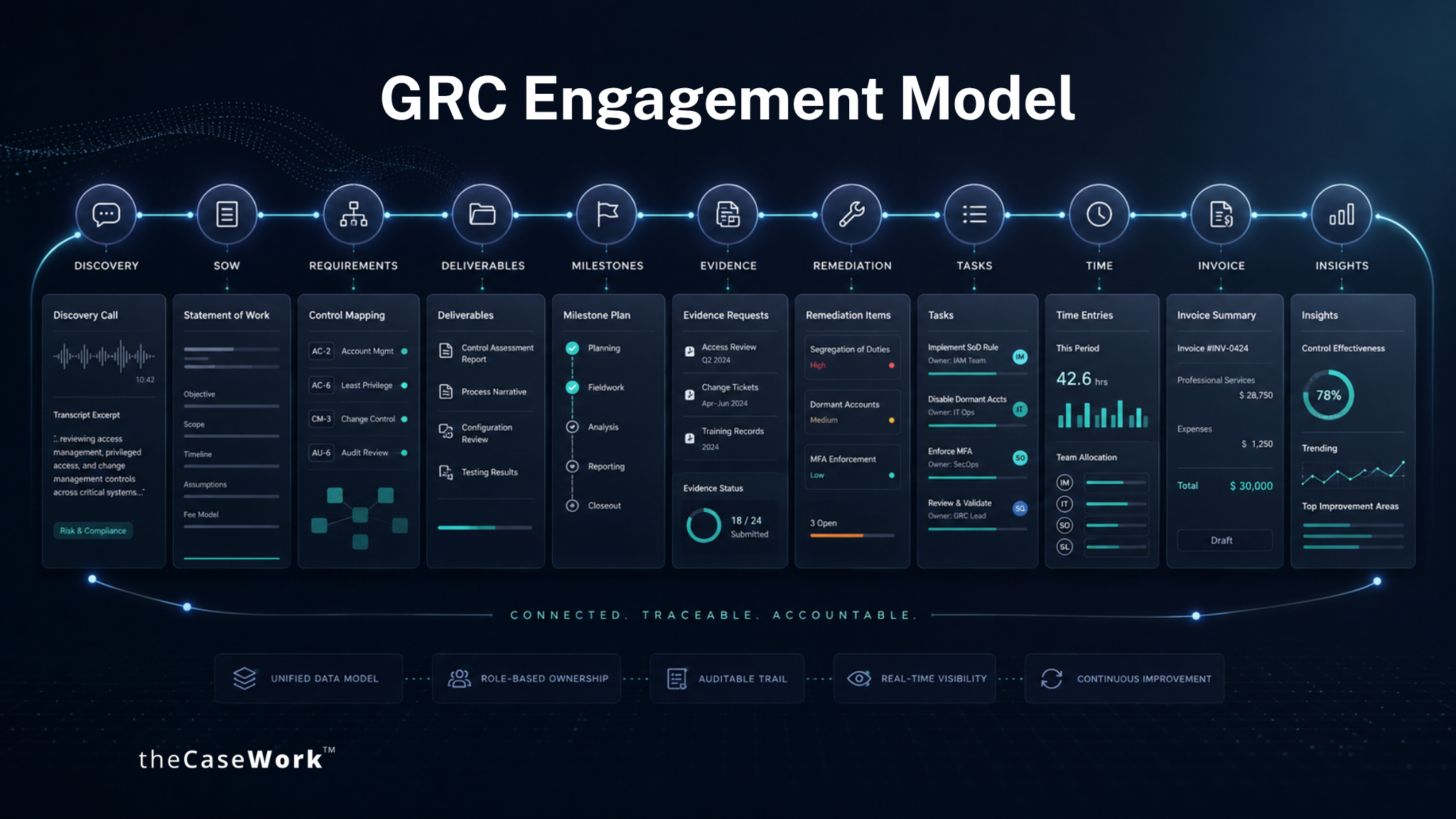
The GRC Engagement Operating Model:
How to Run Client Delivery From Discovery Through Invoice
GRC firms sell expertise, but a surprising amount of margin is won or lost in operations.
The engagement may be technically strong and still be financially weak. The client may get a good result while the delivery team spends far more time than expected. Evidence may eventually arrive, but only after weeks of chasing it. Remediation may get completed, but nobody can say how much unplanned effort it added. The invoice may go out, but only after someone reconstructs what happened from time entries, emails, and spreadsheets.
None of that is a technical GRC failure.
It is an operating failure.
The problem is that many firms do not really have one operating model for client delivery. They have a collection of tools and habits.
Discovery happens in meetings. The SOW is created separately. Requirements live in a spreadsheet. Evidence goes through email or a portal. Tasks sit in a project management system. Time is tracked elsewhere. Billing happens in accounting software. Profitability gets reviewed later.
The operator becomes the integration layer.
That may work when the firm has a handful of engagements and everybody knows what is going on. It becomes much harder as the firm grows.
A better GRC operating model keeps the entire engagement connected:
Agreement → Requirements → Deliverables → Milestones → Evidence → Remediation → Tasks → Time → Invoice → Insights
This is the GRC-specific application of The Execution Chain™. It builds on the same principle we use across professional services: every unit of work should trace backward to what was agreed and forward to revenue and insight.
For GRC firms, requirements, evidence, and remediation deserve their own place in that chain because they are not incidental to the work. They are the work.
Start before the SOW is signed
A strong GRC engagement begins in discovery.
Discovery is where the firm first learns what the client is actually trying to accomplish, which frameworks or requirements matter, what systems are in scope, who the stakeholders are, what deadlines exist, and where the client may already have gaps.
Too often, that information gets summarized into a SOW and then left behind.
Delivery receives the final agreement but not the full operating context that created it.
That is the first handoff problem.
A better model preserves the connection between discovery and the agreement so the delivery structure reflects what was actually discussed.
The SOW should define the scope, commercial terms, deliverables, major milestones, responsibilities, assumptions, and boundaries clearly enough that the engagement can be built directly from it.
If the delivery team has to interpret what sales meant, the engagement has already introduced unnecessary risk.
Turn framework requirements into operating requirements
Once the engagement is defined, the relevant requirements need to become part of the case.
This may include trust services criteria, control requirements, policies, evidence expectations, contractual obligations, regulatory requirements, or auditor requests.
The point is not to duplicate the entire framework inside a project plan.
The point is to make the requirements that drive the engagement operationally visible.
A requirement should connect to the deliverable it supports, the evidence needed to satisfy it, and any remediation work required if a gap is found.
That connection matters because GRC engagements can otherwise become collections of checklists that are difficult to tie back to what the firm is actually responsible for delivering.
Define the deliverables before the work expands
A readiness assessment is not the same as remediation. Remediation is not the same as ongoing monitoring. Auditor support is not automatically included because the client assumed it would be.
These distinctions need to be clear.
The deliverables might include a gap assessment, readiness report, policy package, remediation plan, evidence matrix, testing results, management responses, auditor handoff package, or final report.
Whatever the firm has agreed to produce should have a clear definition of done.
This protects the client because expectations are clearer, and it protects the firm because additional work becomes easier to identify.
That is not about being rigid.
It is about making conscious decisions when the engagement changes.
Use milestones as gates, not just dates
Milestones should do more than tell the team when something is due.
They should define the operating gates that move the engagement forward.
A SOC 2 readiness engagement, for example, might use gates such as:
Scope confirmed → Assessment complete → Gaps prioritized → Controls implemented → Evidence validated → Fieldwork supported → Findings resolved → Final delivery
Each gate should have conditions for completion.
Scope is not complete because the kickoff meeting happened. It is complete when the systems, audit period, criteria, control owners, deliverables, and evidence plan are agreed.
Remediation is not complete because tasks were created. It is complete when the required changes have been implemented, supported with evidence, and retested where necessary.
Evidence is not complete because files were uploaded. It is complete when the required evidence has been received, reviewed, connected to the correct control, and any missing items are known.
That is what turns milestones into a management system.
Manage evidence as an operating workflow
Evidence is one of the biggest sources of delay in GRC delivery because it depends on people outside the consulting team.
The consultant may know exactly what is needed and still be unable to complete the work because a client control owner has not responded.
That means evidence needs structure.
Every evidence request should have an owner, due date, requirement or control, status, and review outcome. Missing items should be visible. Rejected evidence should not disappear into an email thread. Follow-ups should be part of the engagement rather than somebody's private to-do list.
When evidence is managed this way, leaders can distinguish between a delivery problem and a client dependency.
That is important operationally and commercially.
If a fixed-fee engagement is consuming an extra 20 hours because the team has spent three weeks chasing evidence, the firm should be able to see that.
Treat remediation as managed work
Remediation is where many GRC engagements quietly change shape.
The assessment identifies gaps. The client wants help fixing them. New questions emerge. Additional documentation is needed. Controls have to be redesigned. Evidence needs to be retested.
The original engagement starts absorbing work that was not always anticipated when it was priced.
A strong operating model turns every remediation item into structured work with an owner, due date, required evidence, blocker, and retest requirement where appropriate.
It should also be clear whether the remediation work belongs inside the original scope.
That is where scope management becomes much more practical.
Instead of asking at the end whether the engagement went over scope, the firm can see when new remediation work enters the case and decide what to do about it.
Give every task an owner and a reason
Tasks should never float independently inside the engagement.
Every task should support a milestone, requirement, deliverable, evidence need, or remediation action.
This creates traceability.
It also makes bulk operational decisions much easier. If all evidence-related tasks need to move to another team member, the firm should be able to identify that work by what it supports rather than manually scanning task titles.
Clear ownership matters just as much.
A task with no owner is a future delay. A task with three owners is often the same thing with better branding.
The operating model should make accountability obvious.
Use time to monitor the economics while the work is happening
Time is especially important in fixed-fee GRC work because revenue may remain fixed while effort changes constantly.
Leaders should be able to see whether certain milestones, evidence cycles, remediation phases, clients, or engagement types consistently consume more time than expected.
That is what we call time leakage: the difference between what the work was expected to consume and what it actually consumed.
Time leakage is not automatically bad. Sometimes more effort is justified. Sometimes the client approved additional work. Sometimes the firm intentionally invests more time in an important relationship.
The problem is not the extra time.
The problem is not knowing it happened until the margin is gone.
Make billing part of delivery
When work is complete, the path to invoicing should be obvious.
The firm should already know which milestone was completed, what time and expenses were associated with the work, whether any approved scope changes were added, and what the client should be billed.
This is especially important for milestone-based engagements.
If delivery and billing are disconnected, completed work can sit waiting while finance tries to determine whether it is invoice-ready.
That creates unnecessary working-capital pressure and forces another manual handoff between delivery and finance.
The cleaner model is simple: execution should produce the information required to bill.
Use insights to run the firm, not just report on it
The operating model should eventually answer questions leaders care about without requiring another spreadsheet.
Which engagements are drifting?
Where is evidence stalled?
Which milestone types consistently run long?
Which clients generate the most unplanned work?
Where is remediation consuming more effort than expected?
Which engagements are most profitable?
Which work has been completed but has not reached billing?
Which team members are overloaded?
Those answers should come from the engagement itself.
That is how a GRC firm moves from managing individual projects to managing its delivery operation.
Where AI fits
AI becomes much more useful when it operates inside a structured model.
If the underlying engagement is fragmented, AI can summarize the fragmentation. That may save some time, but it does not fix the operating problem.
When the work is structured, AI can do much more.
Casey, the AI assistant inside theCaseWork™, can turn a discovery meeting transcript into a draft SOW and structured case, help build milestones and tasks, analyze operational data, identify time leakage and bottlenecks, recommend next actions, and take approved actions inside the platform.
That is a very different use of AI from adding a chat box to existing software.
The value comes from the combination of intelligence and operating context.
Casey knows the work because theCaseWork™ keeps the agreement, requirements, deliverables, milestones, evidence, remediation, time, billing, and insights connected.
What good GRC operations should feel like
A well-run GRC engagement should not require the engagement lead to hold the entire case in their head.
The team should know what was sold, what phase the engagement is in, what evidence is missing, which remediation items are blocked, who owns each next action, how much time has been consumed, whether scope has changed, and what can be invoiced.
Leadership should be able to see the same story across the entire firm.
That is the point of the GRC Engagement Operating Model.
It is not about adding more process to GRC work. Most firms already have enough process.
It is about connecting the process they already have so the engagement can move from discovery to invoice without losing the commercial and operational context along the way.
Want to see how your current operating model compares? Take the GRC Delivery Health Check, or see how theCaseWork™ connects discovery, SOW, evidence, remediation, time, billing, and profitability in one case.